

Slewing Bearings for Machine Tools

We are always ready for you.
Slewing Bearings for Machine Tools
A Complete Buyer's Guide
What Is a Slewing Bearing?
A slewing bearing (also called a slew ring or rotation bearing) is a large-diameter rolling-element bearing designed to support combined loads - axial, radial, and moment (tilting) loads - simultaneously, while allowing a rotating platform to turn smoothly relative to a fixed base.
Unlike a standard ball bearing, which usually handles only one or two load types, a slewing bearing is built as a compact, self-contained rotation system. It typically integrates:
- An inner ring and outer ring, one of which is usually gear-cut (internal or external teeth) for drive engagement
- Rolling elements - balls or rollers - arranged in one or more rows between the rings
- Mounting holes for direct bolt-on installation, eliminating the need for a separate housing
- Seals to keep contaminants out and lubricant in
This all-in-one design is why slewing bearings are used wherever a large, heavy component needs to rotate precisely and reliably - from construction cranes to satellite antennas to, increasingly, machine tools.
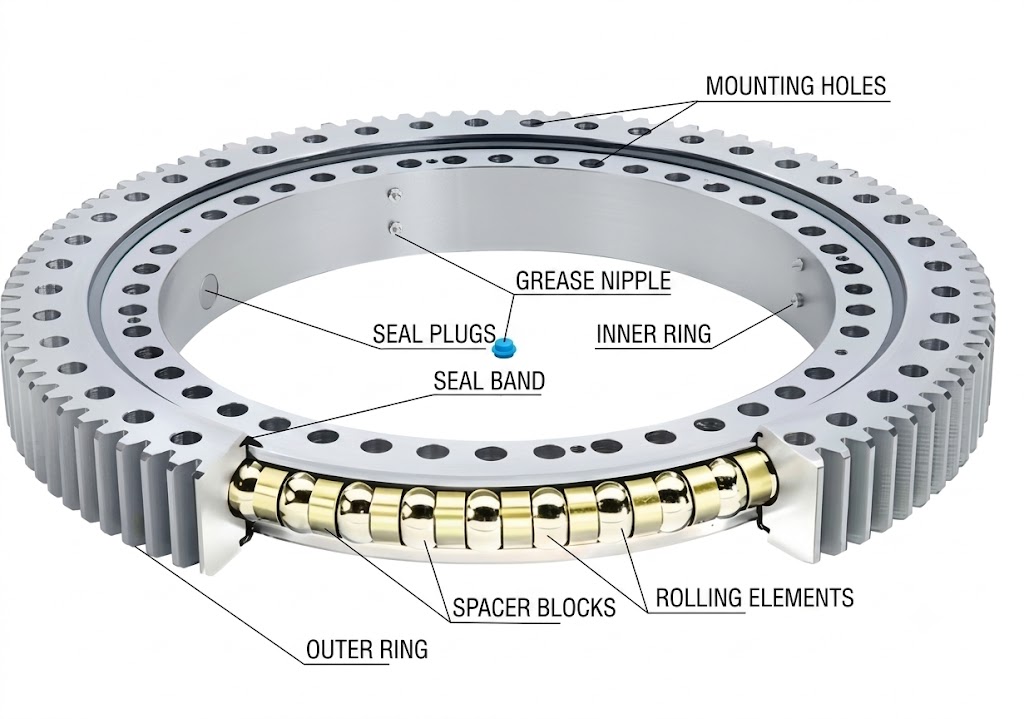
Cross-section of a slewing bearing showing raceways, rolling elements, and integral gear teeth
Why Machine Tools Use Slewing Bearings
In machine tool applications - rotary tables, indexing tables, swivel heads, turntables on grinding or milling centers - the bearing is doing two jobs at once: carrying heavy, often off-center loads, and holding rotational accuracy tight enough to not compromise the machining process itself.
A slewing bearing suits this role because it:
- Handles combined loading in one component. A rotary table carries the weight of the workpiece (axial load), lateral cutting forces (radial load), and tipping moments from off-axis loads - all at once. A slewing bearing is engineered specifically for this combination.
- Delivers high rotational accuracy. Machine tool positioning tolerances are unforgiving. Bearing runout directly affects part accuracy, so precision-grade slewing bearings are manufactured to tight tolerances on raceway roundness and axial/radial play.
- Saves space and simplifies design. Because the bearing itself provides the mounting interface, machine builders avoid stacking separate thrust and radial bearings, reducing assembly complexity and stack-up error.
- Supports long service life under continuous duty. Machine tools often run multi-shift production. Raceway hardness and lubrication retention become critical to avoid pitting and wear over years of operation.
Slewing bearing used in a CNC machine tool .
Types of Slewing Bearings Used in Machine Tools
| Type | Structure | Typical Use in Machine Tools |
|---|---|---|
| Single-row four-point contact ball bearing | One row of balls contacting the raceway at four points | Rotary/indexing tables with moderate loads |
| Double-row ball bearing | Two rows of balls, higher load capacity | Larger rotary tables, heavier fixtures |
| Cross roller bearing | Rollers arranged perpendicular to each other in a single row | Applications needing high rigidity and precision in a compact size - common on precision swivel heads |
| Three-row roller bearing | Separate rows for axial, radial, and moment loads | Very heavy-duty, large-diameter rotary platforms |
Cross roller and four-point contact ball designs are the most common choices where positioning accuracy is the priority, since their construction minimizes internal clearance and elastic deformation under load.
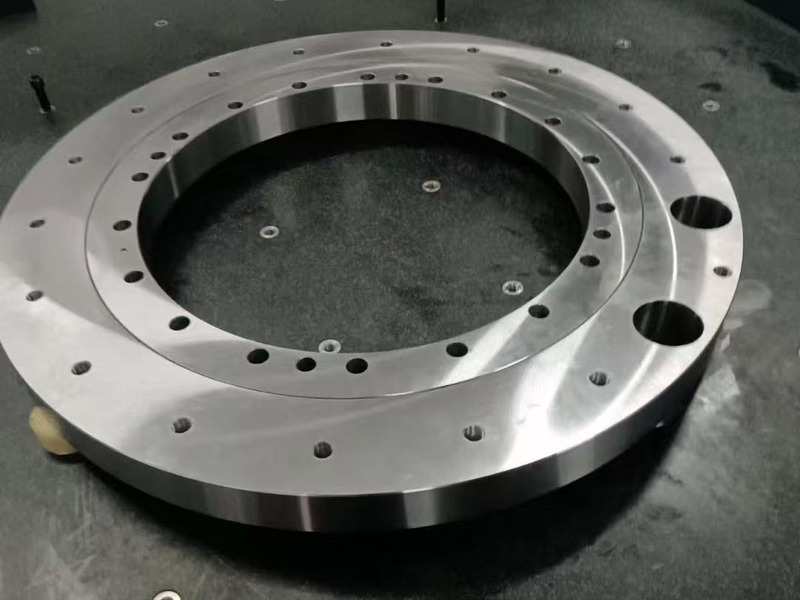
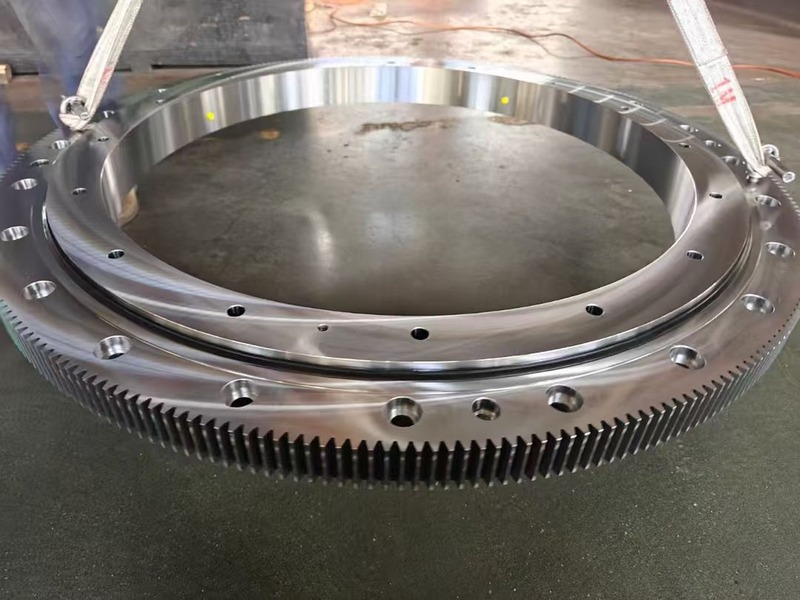
Finished slewing bearing ready for machine tool integration
Key Selection Criteria for Buyers
Sourcing a slewing bearing for a machine tool application isn't just about matching a diameter. Buyers should evaluate:
- Load ratings - static and dynamic axial, radial, and moment load capacity, based on actual duty cycle, not just peak load
- Precision class - runout and rotational accuracy tolerances suited to the machining process (a rough turntable and a precision grinding index table need very different tolerance classes)
- Raceway hardness and material - induction-hardened raceways on medium-carbon alloy steels (such as 42CrMo or 50Mn) resist wear and pitting far better than through-hardened or unhardened raceways under repetitive cyclic loading
- Gear type and module - internal vs. external gearing, and gear module/pitch, must match the drive system
- Sealing - machine tool environments often involve coolant, chips, and dust; sealing quality directly affects bearing lifespan
- Bolt circle and mounting dimensions - must integrate with the existing or planned machine structure
- Rotation speed rating - continuous-duty rotary tables need bearings rated for sustained rotation, not just occasional slewing
How Quality Is Verified
Because a slewing bearing is a load-bearing precision component, not a commodity part, verification matters as much as the spec sheet. Buyers should ask suppliers about:
- Dimensional and geometric inspection - ideally verified with coordinate measuring machines (CMM) to confirm raceway roundness, bolt hole positioning, and gear accuracy against drawing tolerances
- Material certification - mill certificates confirming steel grade and heat treatment
- Hardness testing - confirming raceway surface hardness meets the specified depth and range after induction hardening
- Quality system certification - ISO 9001 process control, and CE compliance where the end product requires it
- Load testing or traceable process records, especially for custom or first-order parts
For custom-diameter bearings (roughly 1-5 meters is a common heavy-duty range for large rotary tables and swivel structures), buyers should also confirm the manufacturer can produce single-piece custom orders - since many large machine tool projects don't need mass-production volumes, just one correctly engineered part.
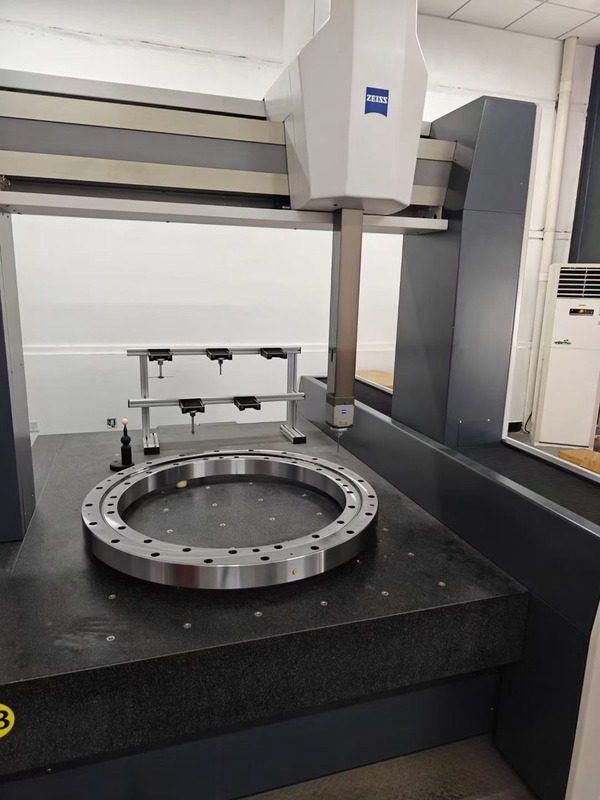
CMM inspection ensuring raceway roundness and dimensional accuracy
Custom vs. Standard Slewing Bearings
Standard catalog slewing bearings work for common rotary table sizes, but many machine tool builders - especially for large gantry mills, heavy grinding centers, or specialized swivel structures - need a bearing engineered to a specific bolt pattern, gear module, or load case that doesn't exist off the shelf.
Custom slewing bearings allow:
- Exact match to existing mounting interfaces (useful for retrofits and rebuilds)
- Load and precision specs tuned to the actual application rather than over- or under-engineered
- Integration of application-specific features, such as non-standard gear teeth or sealing arrangements
The tradeoff is lead time: custom large-diameter slewing bearings typically require several weeks for engineering, forging/rolling, machining, heat treatment, and final inspection - commonly in the range of 30-45 days depending on size and complexity.
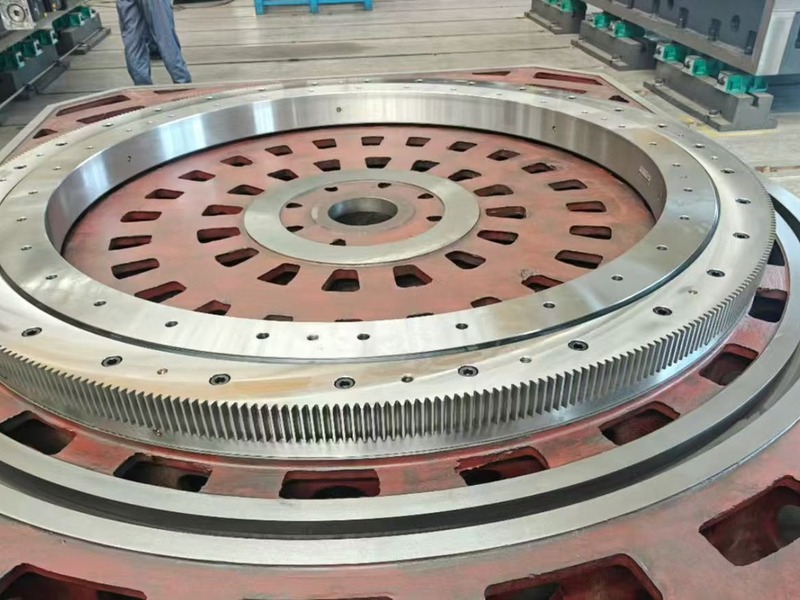
Large-diameter slewing bearing in a production environment
Frequently Asked Questions
What is the difference between a slewing bearing and a regular bearing?
A slewing bearing supports axial, radial, and moment loads simultaneously in one integrated unit with mounting holes and often gear teeth, while a regular bearing (like a deep groove ball bearing) typically handles only one primary load direction and requires a separate housing.
What steel is used for slewing bearing raceways?
Medium-carbon alloy steels such as 42CrMo and 50Mn are common choices, chosen for their ability to achieve high surface hardness through induction hardening while retaining a tougher core.
Can slewing bearings be made in custom sizes?
Yes. Manufacturers with in-house forging, machining, and heat treatment capability can produce custom-diameter slewing bearings - including large sizes in the 1-5 meter range - to match specific mounting and load requirements, often starting from a single piece.
How is slewing bearing precision measured?
Precision is measured through runout testing and dimensional inspection, ideally using a coordinate measuring machine (CMM) to verify raceway roundness, gear accuracy, and mounting hole positions against engineering tolerances.
How long does it take to get a custom slewing bearing made?
Lead times vary by size and complexity, but 30-45 days is a typical range for custom large-diameter slewing bearings, covering material sourcing, machining, heat treatment, and inspection.
Sourcing a slewing bearing for a machine tool project? The right partner should be able to walk you through load calculations, precision classes, and material certification - not just quote a price against a drawing.