

Slewing Bearings for Scrap Handlers and Grab Loaders

We are always ready for you.
Slewing Bearings for Scrap Handlers and Grab Loaders
How the right slewing ring survives the toughest material handling duty
Guide from Anhui Yuanfeng
Quick Answer
A scrap handler or grab loader slewing bearing is the large rotary bearing under the machine's upper structure that lets the cab, boom, and grapple swing through a full working circle while carrying the entire weight of the load. Because these machines grab heavy, uneven loads and swing them thousands of times per shift, their slewing rings face higher tilting moments, harder impacts, and dirtier environments than most excavator bearings - so they need the right type, the right size, and verifiable quality.
Key Takeaways
1. Tilting moment is the design driver: A loaded grapple at the end of a long boom creates an overturning moment far larger than the weight it lifts. Size the bearing by moment capacity, not by static weight.
2. Impact loads punish raceways: Grabbing scrap or digging into a stockpile slams the load into the bearing. Hardened raceways at HRC 55-62 with a proper case depth are what absorb this abuse.
3. Swing frequency wears gear teeth: A handler can complete hundreds of full swings a shift. Gear quality and tooth hardening decide whether the slew drive stays smooth for years or wears out in months.
4. Dust is the silent killer: Scrap yards and ore ports are full of fine abrasive particles. Sealing quality is as important as load capacity in this application.
5. Match the bearing to the machine class: Single-row ball for compact handlers, double-row ball or cross roller for mid-size units, three-row roller for large heavy-duty machines - each has its place.
Where the Bearing Works on a Scrap Handler
A scrap handler - also called a grab loader, grapple loader, or material handler - is a purpose-built machine for moving loose, heavy material. You see them in scrap yards feeding shredders, at ports unloading ore and scrap from ships, and in steel mills handling billets and slabs. They look like excavators, but they are optimized for one job: grabbing a load and swinging it to where it needs to go.
The slewing bearing sits between the tracked or wheeled undercarriage and the upper structure - the cab, boom, and grapple assembly. It carries the full weight of the upper machine plus the load, and it allows the operator to swing the grapple to any point in a circle around the machine. On many handlers, this swing motion is the machine's most frequent movement: pick up scrap, swing 90 to 180 degrees, drop it into a truck or hopper, swing back. All day.
Because of that working pattern, a scrap handler slewing ring is usually selected by tilting moment capacity first. The moment comes from the boom length times the load at the grapple - and when a full grapple of heavy scrap swings out over the side, the force trying to tip the upper structure off the bearing is several times the weight of the load itself.
Why Grab Loaders Are Harder on Bearings Than Excavators
If you have bought slewing bearings for excavators, the scrap handler application still deserves a second look. The differences are not subtle:
| Load Factor | Excavator | Scrap Handler / Grab Loader |
|---|---|---|
| Typical swing | Partial arcs while digging | Full 360-degree loaded swings, constantly |
| Load character | Bucket teeth cut into soil, relatively even fill | Grapple closes on irregular scrap, heavy shocks, uneven center of gravity |
| Environment | Dirt, mud, some dust | Abrasive fines, ore dust, salt air at ports, extreme temperatures |
| Impact events | Occasional (hard ground, rocks) | Every cycle: grapple jaws slamming shut on dense scrap |
The practical result: handlers spec bearings with higher dynamic capacity and better sealing than an excavator of the same size would need. Buyers who reuse an excavator bearing spec for a grab loader often end up with premature raceway wear or a seized slew drive.
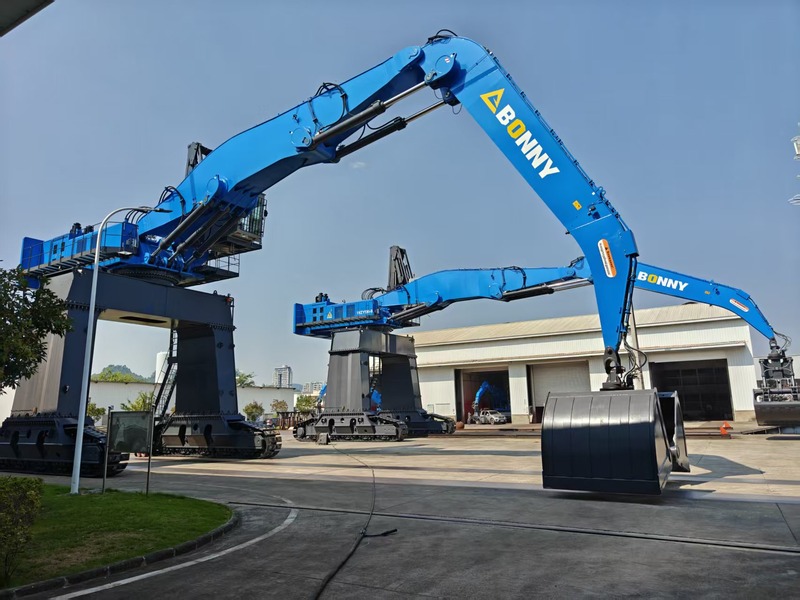
Real Machine Case: 160 Tonnes of Steel, a 10-Tonne Grapple
Consider the scrap handler shown at the top of this guide. The machine itself weighs 160 tonnes - as much as a fully loaded rail car. Its grapple, however, lifts only about 10 tonnes of scrap per cycle. At first glance that seems like a small load for such a large machine. It is not - because the slewing bearing does not carry the machine's weight the way a foundation carries a building.
What the bearing actually resists is the tilting moment: the grapple load multiplied by the working radius of the boom, plus the weight of the boom itself acting at its own center of gravity. A 10-tonne grapple at the end of a long boom creates a moment far larger than 10 tonnes of simple vertical force - and that moment, repeated on every swing and slammed by every grab, is what the bearing raceways and gear teeth must absorb for years.
Why this matters to you: when you ask for a quote, do not say "bearing for a 160-tonne machine." Give the boom length, grapple capacity, and heaviest material - the supplier needs the working radius and the load at that radius to calculate the moment that sizes the ring.
Choosing the Right Bearing Type for the Machine Class
Scrap handlers range from compact 10-tonne machines moving light scrap, to massive port handlers handling 50 tonnes or more of ore in a single grab. The bearing type follows the machine class:
| Bearing Type | Typical Machine | Why It Works |
|---|---|---|
| Single-Row Four-Point Contact Ball | Compact handlers, small grapples (roughly up to 20 tonnes) | Economical, compact, handles combined axial and moment loads well at moderate duty |
| Double-Row Ball | Mid-size scrap handlers and grapples | Higher rigidity and moment capacity than single-row at a moderate cost |
| Cross Roller | Handlers needing precision swing control | Zero-clearance option where swing accuracy and rigidity matter |
| Three-Row Roller | Large port handlers, heavy ore and scrap duty | Maximum moment capacity and rigidity for the biggest machines |
Selection tip: Tell your supplier the machine class, the boom length, the grapple capacity, and the heaviest material you grab - not just "a bearing for a scrap handler." Moment load is what sizes the ring, and it cannot be calculated from machine weight alone.
Four Quality Factors That Decide Service Life
Once the type and size are right, the difference between a bearing that lasts one season and one that lasts a decade comes down to four things:
1. Material and heat treatment
Quality rings start from 42CrMo or 50Mn steel. The raceways are induction-hardened to HRC 55-62, and the hardened layer depth is what resists rolling-contact fatigue under repeated impact. Confirm the hardening specification in writing - material grade, surface hardness, and case depth - before you order. A supplier who can document the process is a supplier who can be audited.
2. Gear teeth accuracy and hardness
Most handlers slew through an internal or external gear ring driven by a hydraulic motor and pinion. With hundreds of swings per shift, tooth profile, pitch, and hardness decide how long the drive stays smooth. Inspect tooth quality and confirm the gear heat treatment with the same rigor as the raceways.
3. Sealing for abrasive environments
Scrap fines and ore dust will find their way into any gap. Multi-lip seals and labyrinth protection keep the raceway clean and the grease in place. If a quotation does not state the seal arrangement, ask for it - in this application, sealing is a life-or-death detail.
4. Measured, documented quality
Every ring should be inspected on a coordinate measuring machine, with a report that travels with the product. Traceability - material batch, heat treatment records, final dimensions - turns a component into a documented part of your machine's history.
What to Ask a Supplier - and What Yuanfeng Provides
Whether you are an OEM building handlers or a dealer sourcing replacements for an existing fleet, the questions are the same: Do you manufacture in-house? What steel grades do you use? How do you verify raceway and gear hardening? Can I see a CMM report from a recent production ring?
At Anhui Yuanfeng, we machine, heat treat, grind, and assemble slewing rings in-house in Hefei, China - from 200 mm to 6,000 mm in diameter, in single-row ball, double-row ball, cross roller, and three-row roller designs, with internal or external gearing as specified. Our material grades are 42CrMo and 50Mn; raceways are induction-hardened to HRC 55-62. Every unit is measured on a Zeiss CMM and carries a unique product ID with full traceability. Our MOQ is 1 piece, and standard custom production takes about 40 days - which means even a single replacement ring for a working handler is practical, not a factory-scale commitment.
Frequently Asked Questions
Quick answers for scrap handler and grab loader buyers
Q: What size slewing bearing does a scrap handler need?
Sizing follows the tilting moment, not the machine weight. Compact handlers typically use rings from about 500 mm to 1,200 mm diameter; large port handlers can require 2,000 mm or more. Leave a message with your machine class, boom length, and grapple capacity for an accurate recommendation.
Q: Single-row ball or three-row roller for a grab loader?
For compact and mid-size handlers with moderate duty, single-row four-point contact ball rings are economical and reliable. For large machines, heavy grabs, or constant full-load swinging, three-row roller rings offer maximum moment capacity and rigidity. Mid-size heavy-duty units often use double-row ball.
Q: What causes slewing bearing failure on scrap handlers?
The most common causes are contaminated raceways from failed seals, insufficient raceway case depth under impact loads, and gear tooth wear from aggressive slewing. Regular greasing, seal inspection, and documented heat treatment from the start prevent most failures.
Q: Can you supply a replacement bearing for an existing handler brand?
Yes. Provide the bearing's dimensions, bolt pattern, gear specification (module, tooth count, internal or external), and any markings from the original ring. We manufacture custom replacements with a 1-piece MOQ and about 40 days of production time.
Q: How often should a grab loader bearing be re-greased?
For continuous multi-shift operation, re-grease daily or every 8-10 hours of work; for lighter duty, weekly is often enough. Always purge old grease until fresh grease exits the seal gaps, and follow the bearing's lubrication schedule in dusty conditions.
Specifying a handler bearing? Leave a message - our engineers reply within 24 hours.
Editor & Layout: Daphne Hsu
Anhui Yuanfeng Slewing Rings Co., Ltd.
CE & ISO 9001 Certified Manufacturer
Web: www.ahyfeng.com | Email: office@ahyfeng.com / Daphne@ahyfeng.com
Tel| WhatsApp: +86-18298009271 ;+86 13965019293