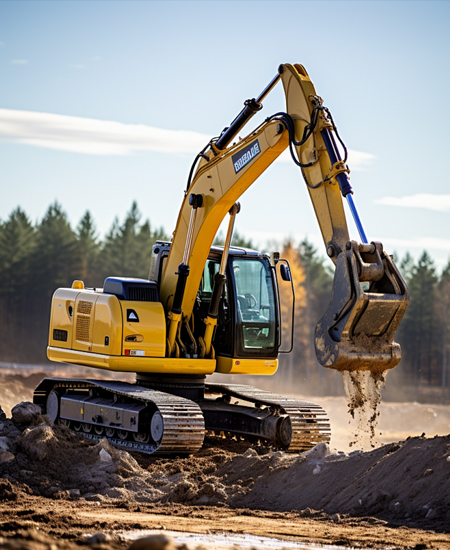



What Is a Rotary Table Bearing?

We are always ready for you.
What Is a Rotary Table Bearing?
A beginner's guide to cross roller and four-point contact ball bearings for machine tool buyers
Guide from Anhui Yuanfeng Slewing Rings Co., Ltd.
Quick Answer
A rotary table bearing is a precision slewing bearing used in CNC machine tools such as boring machines, milling machines, and vertical lathes. It supports a rotating worktable, holds it steady under cutting force, and turns it to a new angle without losing position. The two most common designs are the four-point contact ball bearing and the cross roller bearing. Which one is right for you depends on the stiffness, accuracy, and load requirements of your application - not on the diameter alone.
Key Takeaways
1. Two designs cover most machine tools: four-point contact ball bearings are simple and cost-effective; cross roller bearings deliver much higher rigidity in a compact section, which is why precision rotary tables and indexing heads use them.
2. Stiffness decides machining accuracy: stiffness is load divided by deformation. A bearing that deflects 0.01 mm more than another puts that error straight into the finished part.
3. Preload removes clearance, but costs friction: a zero-clearance (preloaded) bearing is more rigid and more precise, and it also runs hotter. Selection is about balance, not maximum preload.
4. Machine tool tables normally need P4 or P2 accuracy: standard grades are P0, P5, P4, and P2 - the lower the number, the higher the precision. Errors in the bearing are magnified in the workpiece.
5. Send parameters, not just a diameter: available radial space, radial and axial load, tilting moment, required accuracy, and whether the bearing carries gear teeth - these five items allow a real calculation instead of a guess.
Why Machine Tools Need a Special Kind of Bearing
A standard bearing is designed to let a shaft spin freely. A rotary table bearing has a different job: it must hold a heavy worktable - often loaded with a large workpiece - perfectly steady while the cutting tool pushes against it from the side, and then rotate that table to a new precise angle without losing position.
This is what makes multi-face machining possible. Instead of unclamping a workpiece and re-fixturing it for every face, a 5-axis machining center rotates the table to the next angle automatically. The accuracy of that rotation depends almost entirely on the bearing underneath the table.
That is why a rotary table bearing is really a precision positioning component, not a simple rotating support. It carries combined axial load, radial load, and tilting moment at the same time, in a structure that has to stay stiff for years of production.
Three Concepts Every Buyer Should Understand
Before comparing bearing types, three terms come up in almost every technical conversation about rotary table bearings.
1. Stiffness
Stiffness describes how much a bearing deforms under load. Cutting forces constantly push and twist the table during machining. If the bearing is not stiff enough, that force causes a small deflection, and the deflection shows up directly as a dimensional error on the finished part. A simple way to think about it: stiffness equals load divided by deformation. The less a bearing moves under a given load, the higher its stiffness.
2. Clearance and Preload
Clearance is the small internal gap between the rolling elements (balls or rollers) and the raceway. Too much clearance means the table can wobble slightly during rotation. To solve this, precision bearings use preload - the rolling elements are compressed slightly during assembly, removing clearance entirely (a zero-clearance design). The trade-off: more preload generally means higher stiffness and precision, but also more friction and heat. Bearing selection is usually about finding the right balance for the application.
3. Accuracy Grade
Bearing precision is classified in standard accuracy grades, commonly written as P0, P5, P4, and P2 - the lower the number, the higher the precision. Machine tool applications typically call for P4 or P2 grade bearings, because even small errors in the table position are amplified in the final machined part.
Cross Roller vs. Four-Point Contact Ball: What Is the Difference?
These are the two most common rotary table bearing designs. In practice the choice usually comes down to available space and precision requirements.
Four-Point Contact Ball Bearing
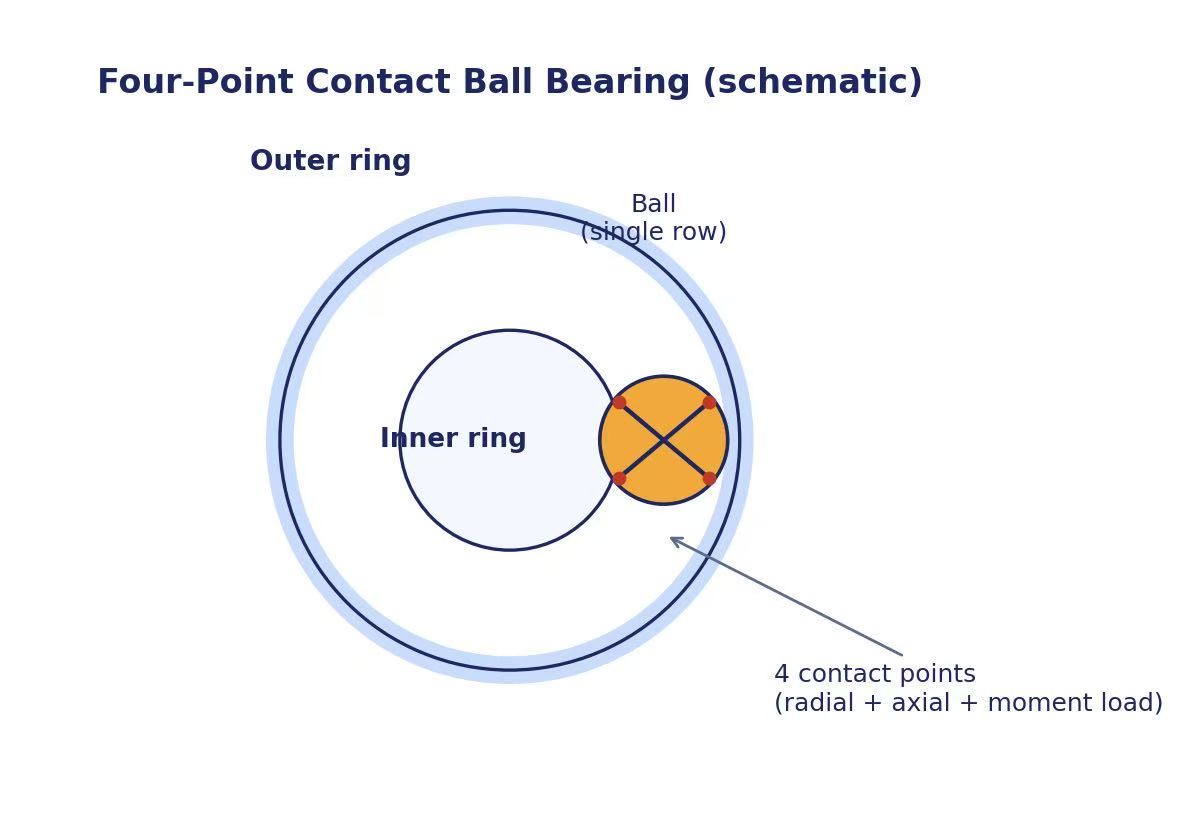
Four-point contact ball bearing: one row of balls, four contact points, combining radial, axial, and moment capacity in a simple structure.
In this design a single row of balls sits between the inner and outer ring. Each ball touches the raceway at four contact points, which allows one row of balls to carry radial load, axial load, and tilting moment at the same time. It is a simple, cost-effective structure - but because contact is at a point rather than along a line, stiffness is naturally more limited than in a roller-based design.
Best suited for: general-purpose rotary applications, moderate precision requirements, cost-sensitive projects.
Cross Roller Bearing
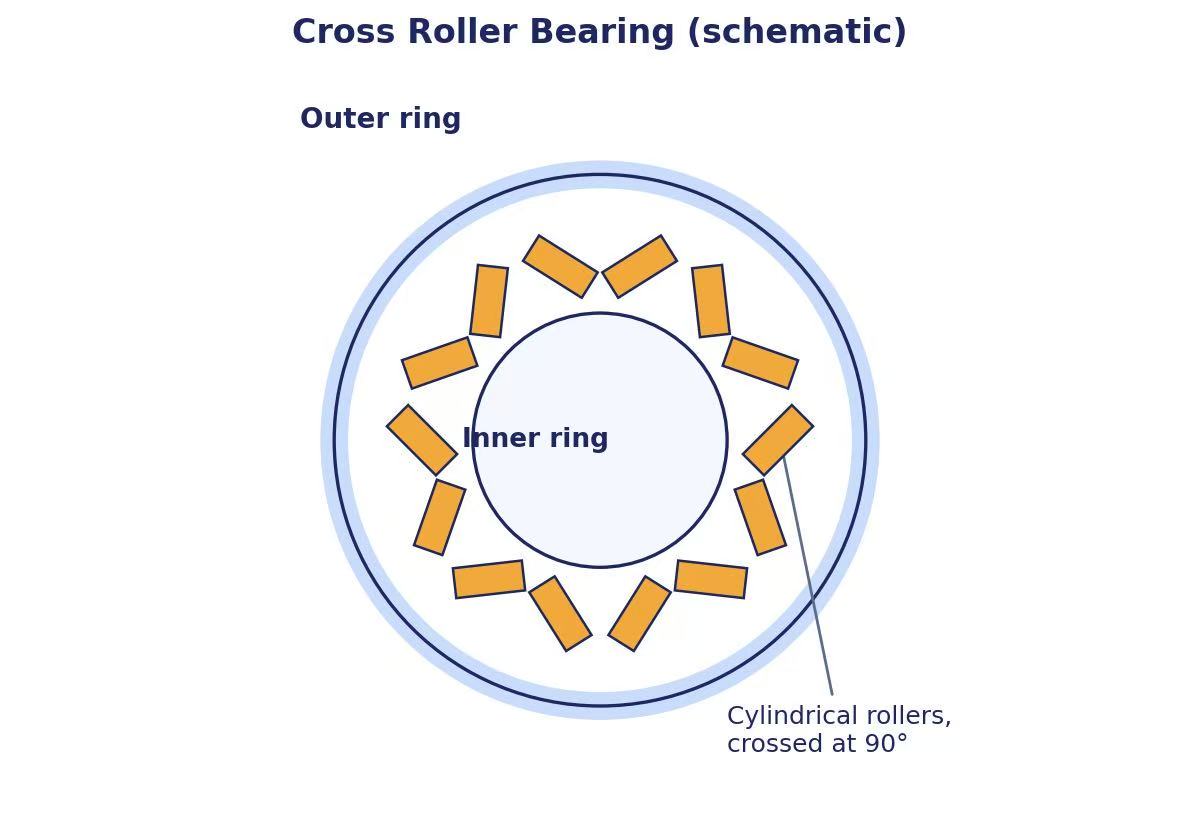
Cross roller bearing: cylindrical rollers arranged at 90 degrees to each other, giving line contact and high rigidity in a thin radial section.
Here cylindrical rollers are arranged in an alternating pattern, each rotated 90 degrees relative to its neighbour. Because rollers make line contact with the raceway instead of point contact, a cross roller bearing achieves significantly higher rigidity in a more compact radial section. That is exactly why it is the standard choice for CNC rotary tables, indexing heads, and robotic joints, where both space and precision matter.
Best suited for: high-precision CNC rotary tables, applications with limited radial space, and situations requiring high stiffness under combined loading.
Quick Comparison
| Property | Four-Point Contact Ball | Cross Roller |
|---|---|---|
| Contact type | Point contact | Line contact |
| Stiffness | Moderate | High |
| Radial section | Standard | Can be thinner for the same load |
| Typical accuracy | P5 to P4 | P4 to P2 |
| Cost | Lower | Higher |
| Common use | General rotation, lighter duty | Precision CNC tables, indexing heads, robotics |
How to Choose the Right Bearing for Your Application
A few practical questions to work through before you request a quotation:
| 1. Space | What is your available radial section? If the centre bore must stay large relative to the outer diameter, a cross roller design usually uses the limited section better. |
| 2. Accuracy | What does your process require? For tight positioning tolerance - multi-face precision machining, for example - lean toward a cross roller design with the appropriate preload. |
| 3. Loads | What are your actual radial load, axial load, and tilting moment values? Share these with your supplier - they are what allow a proper stiffness and life calculation instead of a guess. |
| 4. Gearing | Do you need integrated gear teeth? Some tables are driven directly by a pinion meshing with teeth cut into the bearing itself, which saves space compared with a separate ring gear. |
| 5. Environment | What is the working environment? Coolant, grinding dust, and chips all attack the seals and the raceway. Sealing and lubrication arrangement belong in the specification, not in the aftermarket. |
Selection tip: a rotary table bearing cannot be sized from machine weight alone. Give your supplier the table load, the cutting force direction and magnitude, the required angle accuracy, and the available mounting space - that is everything needed to specify the right ring.
What Decides Service Life - and What Yuanfeng Provides
Once the type and size are right, the difference between a bearing that holds accuracy for a decade and one that needs replacing in a season comes down to material, heat treatment, grinding, and inspection.
1. Material and heat treatment
Quality rings start from 42CrMo or 50Mn steel. Raceways are induction hardened to HRC 55-62, and the hardened layer depth is what resists rolling contact fatigue under repeated cutting loads. Ask for the hardening specification in writing - material grade, surface hardness, and case depth - before you order.
2. Gear teeth accuracy
If the table is driven through a gear ring, tooth profile, pitch accuracy, and tooth hardness decide how long the drive stays smooth and how much backlash appears over time. Gear quality deserves the same level of documentation as the raceway.
3. Measured, traceable quality
Every ring should be measured on a coordinate measuring machine, with a report that travels with the product. Traceability - material batch, heat treatment records, final dimensions - is what turns a purchased component into a documented part of your machine's quality record.
At Anhui Yuanfeng Slewing Rings Co., Ltd., we machine, heat treat, grind, and assemble slewing rings in-house in Hefei, China. Our standard range covers diameters from 200 mm to 6,000 mm in single-row four-point contact ball, double-row ball, crossed roller, and three-row roller designs, with internal or external gearing as specified. Rings are produced from 42CrMo and 50Mn, raceways are induction hardened to HRC 55-62, and every unit is measured on a Zeiss CMM with a unique product ID for full traceability. Our minimum order is 1 piece and standard custom production takes about 40 days - so a single replacement ring for a working machine tool, or a first prototype article for a new table design, is practical rather than a factory-scale commitment.
Frequently Asked Questions
Quick answers for machine tool buyers specifying a rotary table bearing
Q: What is the difference between a rotary table bearing and an ordinary bearing?
An ordinary bearing rotates a shaft and mainly carries one load direction. A rotary table bearing carries axial load, radial load, and tilting moment at the same time, and it also has to hold the table in a precise angular position while a cutting tool pushes against it. That combination is why it is built as a slewing ring with hardened raceways and a controlled clearance or preload setting.
Q: Cross roller or four-point contact ball for a CNC rotary table?
Most precision CNC rotary tables and indexing heads use crossed roller bearings, because line contact gives higher rigidity in a thin radial section. Four-point contact ball bearings remain the better economic choice for general rotation, moderate precision, and lighter duty. If your table needs both a large centre bore and high stiffness, a crossed roller design usually wins.
Q: What accuracy grade should I specify for a machine tool table?
Machine tool applications typically call for P4 or P2 grade. The correct grade follows your positioning tolerance: work backward from the accuracy your finished part needs, then allow for the rest of the machine structure. If your process tolerance is generous, a P5 grade ring can be a sensible cost saving.
Q: Can a rotary table bearing be supplied with gear teeth and a large bore?
Yes. Slewing rings can be manufactured with internal or external gear teeth cut into the ring, so the table is driven directly by a pinion and no separate ring gear is needed. Provide the module, tooth count, pressure angle, and whether the gear is internal or external, together with the required bore and mounting dimensions.
Q: What is the minimum order and lead time for a crossed roller bearing?
Our minimum order is 1 piece, and standard custom production takes about 40 days. Diameters from 200 mm to 6,000 mm are covered by our in-house machining, heat treatment, grinding, and assembly, with each ring measured on a Zeiss CMM and shipped with its inspection record.
Q: What information do you need to quote a rotary table bearing?
A drawing or the key parameters: inner and outer diameter, height, mounting hole pattern, gear specification if applicable, radial load, axial load, tilting moment, required accuracy grade, and preload or clearance requirement. With those figures an engineer can confirm feasibility and come back with a calculation rather than an estimate.
Specifying a bearing for a rotary table or a machine tool axis? Leave a message - our engineers reply within 24 hours.
Editor & Layout: Daphne Hsu
Anhui Yuanfeng Slewing Rings Co., Ltd.
CE & ISO 9001 Certified Manufacturer
Web: www.ahyfeng.com | Email: office@ahyfeng.com / Daphne@ahyfeng.com
Tel| WhatsApp : +86-18298009271 : +86 13965019293