

Slewing Bearing Selection
We are always ready for you.
Slewing Bearing Selection
A Practical Guide for First-Time Buyers
Sourcing your first slewing ring? Here is what you need to know.
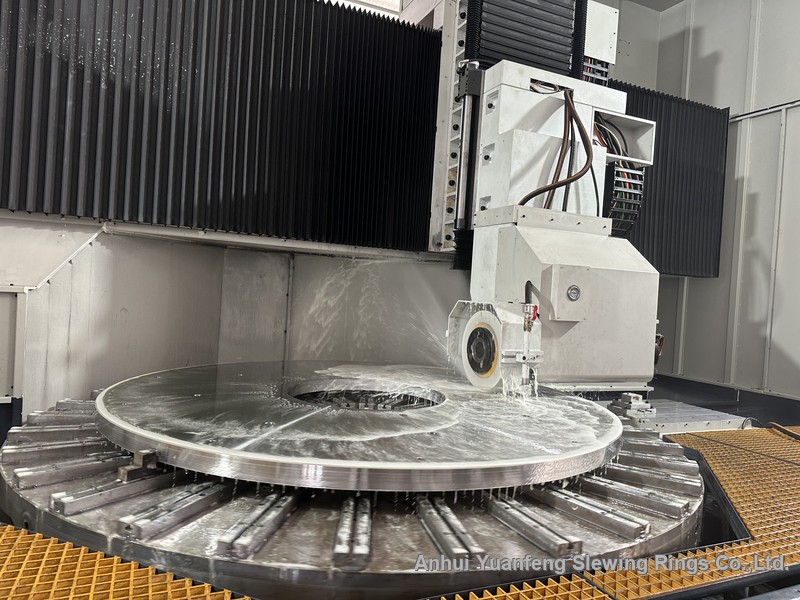
What is a slewing bearing? It is a large-diameter rotation bearing that supports a rotating platform while carrying axial, radial, and moment loads simultaneously. Unlike a standard bearing, it comes as a self-contained unit with inner ring, outer ring, rolling elements, mounting holes, and often integrated gear teeth, bolted directly onto a structure without a separate housing.
For first-time buyers, slewing bearing spec sheets can feel overwhelming. This guide walks through the key decisions you will need to make, explains what the technical terms actually mean for your application, and helps you ask the right questions when comparing suppliers.
1. Understand Your Load
Three forces every spec sheet expects you to know
Every slewing bearing supplier will ask about load. But "load" is not one number -- it is three. Getting these right is the single most important step in selecting the correct bearing.
Axial Load
Force acting along the rotation axis -- straight up or down. A heavy workpiece on a rotary table pressing straight down is purely axial load. Most applications have some axial component.
Radial Load
Force acting sideways, perpendicular to the rotation axis. Lateral cutting force on a machine tool table, or a crane arm swinging sideways. Often smaller than axial and moment loads in crane-type applications.
Moment Load (Tilting Moment)
Not a single-direction push, but a force trying to tip the bearing over. It happens when a load is offset from the bearing centerline -- like a crane lifting at the end of an extended arm. This is often the dominant load in boom-type equipment and the one most commonly under-estimated by first-time buyers.
Why it matters: Different applications produce different load combinations. A machine tool rotary table is axial-load-dominant. A crane sees significant axial, radial, and moment loads simultaneously. A supplier who only asks "how heavy is your load?" without separating these three is likely under-specifying the bearing.
2. Choose the Right Bearing Structure
Four standard types, each with a different design purpose
Slewing bearings come in a few standard internal configurations. Choosing the right one depends on your load magnitude, precision requirements, and budget:
| Type | Load Capacity | Precision | Best For |
|---|---|---|---|
| Single-Row Ball | Moderate | Standard | General rotary tables, small cranes, aerial platforms |
| Double-Row Ball | Moderate-High | Standard | Medium cranes, larger rotary tables |
| Cross Roller | High | Very High | CNC rotary tables, automation, robotics, precision machinery |
| Three-Row Roller | Ultra-High | High | Large excavators, mining equipment, wind turbines, port machinery |
Selection tip: If your application requires high rotational accuracy and zero clearance (e.g. a CNC machine rotary table), the cross roller type is the standard choice despite its higher cost. If load capacity is your primary concern and precision is secondary, a three-row or double-row ball design may offer better value.
3. Materials and Heat Treatment
What goes into a long-lasting bearing
Two steel grades dominate the slewing bearing industry: 42CrMo and 50Mn. Both are alloy structural steels, but they serve slightly different roles:
42CrMo (Chromium-Molybdenum Alloy)
Higher toughness and impact resistance. Responds exceptionally well to induction hardening of the raceway. Preferred for bearings that see shock loads, frequent starts and stops, or where reliability under variable loading is critical. Typical hardness after quenching and tempering: HRC 28-32 core, with raceway surface hardened to HRC 55-62.
50Mn (Manganese Steel)
Good wear resistance at a lower material cost. Adequate for moderate-load applications where the load spectrum is predictable and shocks are minimal. Common in smaller bearings or cost-sensitive projects.
Raceway Induction Hardening
The raceway is the grooved track where the rolling elements actually roll. Induction hardening heats only the raceway surface layer (typically 2-4 mm deep) using rapid localized heating followed by fast cooling, leaving the steel core tougher and less brittle. This combination -- hard surface, tough core -- lets the raceway resist millions of rolling cycles without cracking.
Buyer tip: Hardened layer depth (the actual measured thickness of the hardened surface) is one of the most commonly under-disclosed specs in the industry. Ask your supplier for a hardness-gradient test report -- preferably from a third-party lab. A depth of 2-4 mm is typical for most slewing bearing raceways, but confirming this with data is better than trusting a single number in a quote.
4. Precision and Quality Verification
How to tell if the bearing will actually meet its spec
Precision is typically expressed as a runout tolerance -- how much the raceway deviates from a perfect circle during rotation. For general rotation tasks, looser tolerances are acceptable. For machining centers or applications requiring accurate positioning, tighter precision classes are specified.
CMM Inspection
A Coordinate Measuring Machine (CMM) is the standard method for verifying whether a custom or precision-grade bearing actually meets its drawing tolerances before shipment. It measures raceway roundness, bolt hole positions, gear tooth accuracy, and other critical dimensions. A supplier with in-house CMM capability can provide an inspection report for every custom bearing -- ask for it.
5. Custom vs. Standard Sizing
When off-the-shelf does not fit
Many slewing bearing applications call for dimensions, bolt patterns, or gear configurations that are not available in standard catalogs. This is especially common for machine tool rebuilds, equipment retrofits, or non-standard structures where the original bearing needs a direct replacement.
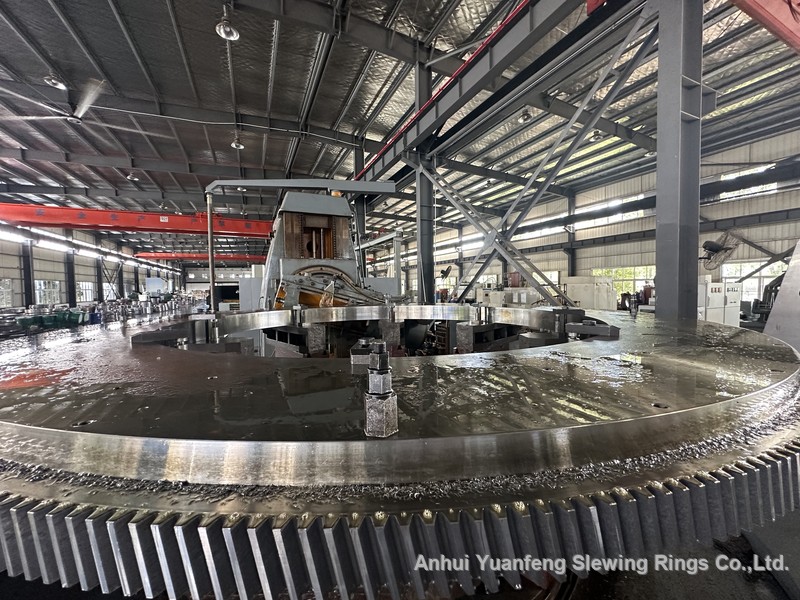
A custom slewing bearing is engineered to the buyer's specific bolt pattern, load case, gear module, and dimensions. Manufacturers with in-house forging, machining, and heat-treatment capability can typically produce custom sizes starting from a single piece -- no mass-production minimum is required.
What to provide for a custom quote: A dimensioned drawing or a sketch showing the bolt circle, inner/outer diameter, overall height, gear module and tooth count (if applicable), and load conditions. If you do not have a drawing, a description of the mating structure and application is enough for an experienced manufacturer to suggest a suitable design.
6. How to Get Started
When you are ready to source a slewing bearing, here is a simple checklist to gather before contacting suppliers:
1. Application type (crane, machine tool, wind turbine, etc.)
2. Estimated loads -- axial, radial, and moment separately
3. Required inner diameter, outer diameter, and overall height
4. Rotation speed and precision requirements
5. Gear specifications -- internal or external teeth, module, number of teeth
6. Operating environment (indoor, outdoor, temperature range, moisture, dust)
7. Target quantity and delivery timeline
A supplier with experience across multiple industries can often suggest the most cost-effective configuration once these basics are clear. Do not hesitate to send a rough sketch or describe your existing setup -- even incomplete information is enough for a preliminary recommendation.
Have a Project in Mind?
Send us your application details or a drawing, and we will recommend the right slewing bearing configuration for your needs.
Email: office@ahyfeng.com;Daphne@ahyfeng.com;Editor & Layout: Daphne Hsu
Anhui Yuanfeng Slewing Rings Co., Ltd.
CE & ISO 9001 Certified Manufacturer
Tel&What's app: +86-18298009271 | WhatsApp: +86 13965019293