

How to Mount a Slewing Bearing

We are always ready for you.
How to Mount a Slewing Bearing
A practical checklist for the workshop: the mounting face, the bolts, the clearance check and the first few weeks
Guide from Anhui Yuanfeng Slewing Rings Co., Ltd.
Quick Answer
Mount a slewing bearing on a flat, clean, rigid surface, tighten grade 10.9 bolts in two diagonal passes, check that the ring turns freely, and measure the axial clearance once before the machine runs. Most early bearing failures are decided in these four steps. The bearing takes the shape of whatever it is bolted to, so a flange that is not flat or not stiff enough will wear out a good ring.
Key Takeaways
1. The flange is part of the bearing. Both rings must sit fully on a machined, flat surface. Do not mount on a flame cut face, on a painted face, or on a flange that flexes under load.
2. Use the right bolts. Grade 10.9 hex bolts with hardened flat washers, threads lightly oiled, and a joint thick enough that the bolt clamps rather than stretches.
3. Tighten in two passes. Half torque first, full torque second, always in a diagonal pattern. Never pull one side down before the others.
4. Write the clearance down. One dial gauge reading taken on the new machine is the only clean reference for every wear check that follows.
5. Come back and retighten. The bolts settle in the first weeks. Retighten once between the third and twelfth week, then at least once a year.
1. Before the Ring Goes On
Work in a clean, dry place. Take the ring out of its packaging only when you are ready to fit it, and keep it flat on a surface that supports the whole side face. Lift it with proper tackle, never with a single sling or one eyebolt, because a ring of this diameter is thin walled and will deform.
Remove burrs from both mounting faces and from the bolt holes. A burr under the ring lifts it locally and puts the whole raceway out of round.
Clean and dry both faces. No oil, no grease, no paint between ring and flange. Remove the factory preservative from the faces that will be in contact.
Check that the faces are flat and fully supported. The flange should be machined after welding, not flame cut, and it should support the ring over the complete circumference and the full width of the face. A thick cylindrical flange with a machined face behaves far better than a thin fabricated frame. If the flange is thin or flexible, tell us before the order, because the bearing capacity then has to be reviewed for that arrangement.
Set the ring down so the bolt holes line up, and check with a straight edge or feeler gauge that it sits level all round before any bolt is tightened.
2. Bolts and Washers
Use grade 10.9 hex bolts and nuts, with hardened flat washers under the head and under the nut to spread the pressure on the flange. Never use spring washers on a slewing ring joint, and never reuse bolts that have already been tightened on another bearing.
Two practical points decide whether the joint holds. First, the clamped length of the joint should be at least five times the bolt diameter: an M24 bolt needs about 120 mm of material between the head and the nut. Second, the threads should be coated with a thin layer of light oil, nothing more; grease or anti seize paste changes the friction and the torque no longer produces the preload you expect.
| Bolt size | Tightening torque, grade 10.9 |
|---|---|
| M16 | 285 Nm |
| M20 | 560 Nm |
| M24 | 970 Nm |
| M30 | 1930 Nm |
Values for grade 10.9 bolts with lightly oiled threads. If the drawing that comes with your bearing states a torque, use that value.
3. Tightening: Two Passes, Diagonal Order
1. Fit all bolts and nuts with the washers and tighten them by hand.
2. First pass: go round the ring in a diagonal pattern and tighten every bolt to about half of the final torque. This seats the ring evenly.
3. Second pass: go round again in the same order and tighten to full torque.
4. If the machine has a second support structure on the other ring, fit it with the same marks 180 degrees apart and repeat both passes.
Some rings are marked on the face where the induction hardening starts and ends. If yours is marked, place that mark away from the heaviest loaded part of the ring, roughly 90 degrees from it.
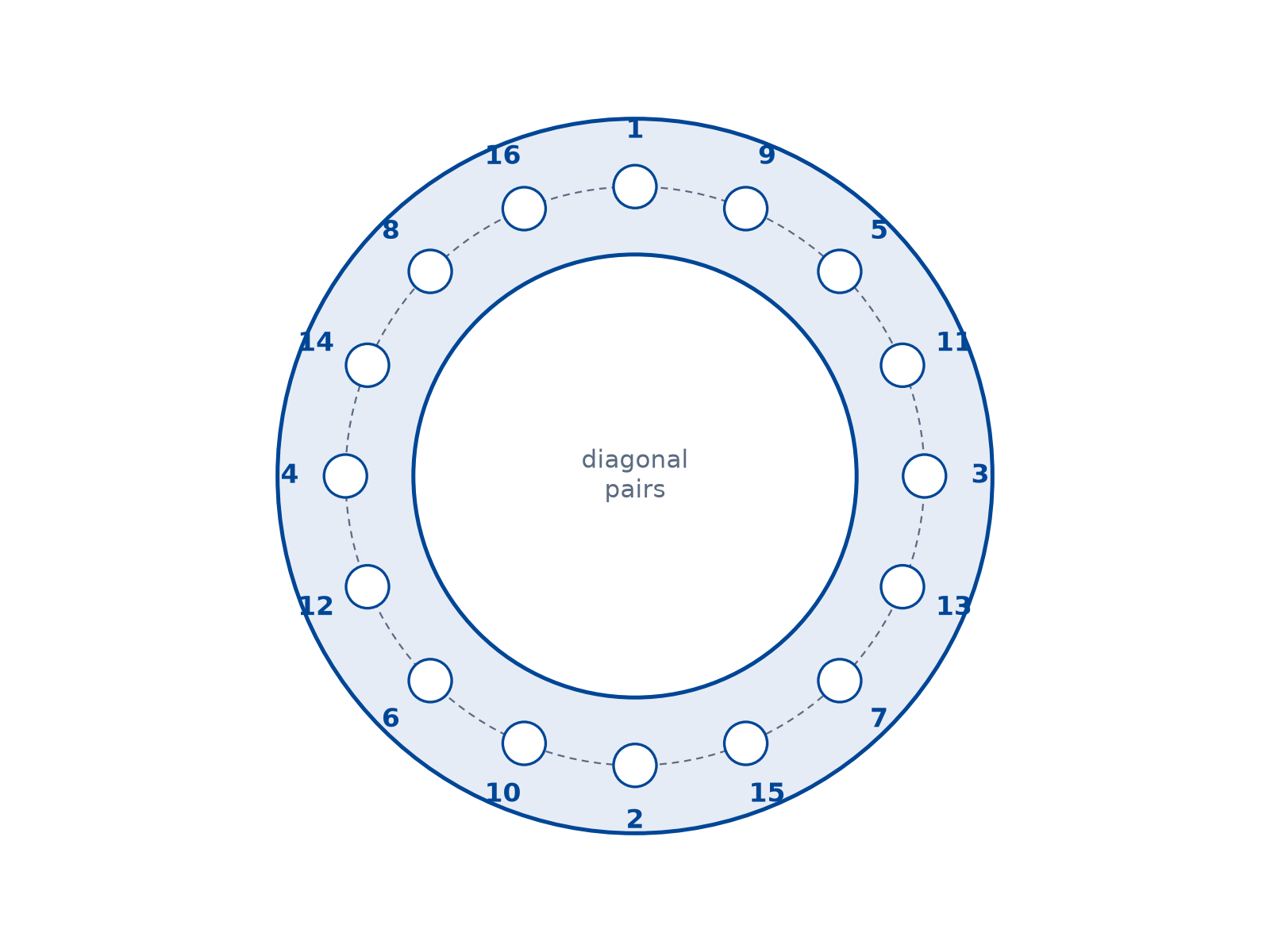
Tighten in opposite pairs, working round the ring. Both passes use the same order: half torque first, full torque second.
4. Checks After Tightening
Turn the free ring by hand. It will not spin easily, because of preload, grease and the seals, but the effort must be the same all the way round. A tight spot that appears once per turn means the ring is out of round, usually because the flange is not flat. Release the bolts of the high spot, check the face and try again rather than forcing it.
Then measure the axial clearance once, with a dial gauge on the ring face, and write the reading in the machine file together with the date. Every later inspection compares against that number, so wear becomes a measured trend instead of an opinion. Measure at the same place, with the same setup, every time.
If the ring is geared, check the backlash with a feeler gauge after the pinion is in place, at the tooth the ring is marked with. For the gear modules used on slewing rings, the working range is roughly 0.3 to 0.9 mm depending on module. Zero backlash is not the goal: it overloads the teeth and shortens gear life.
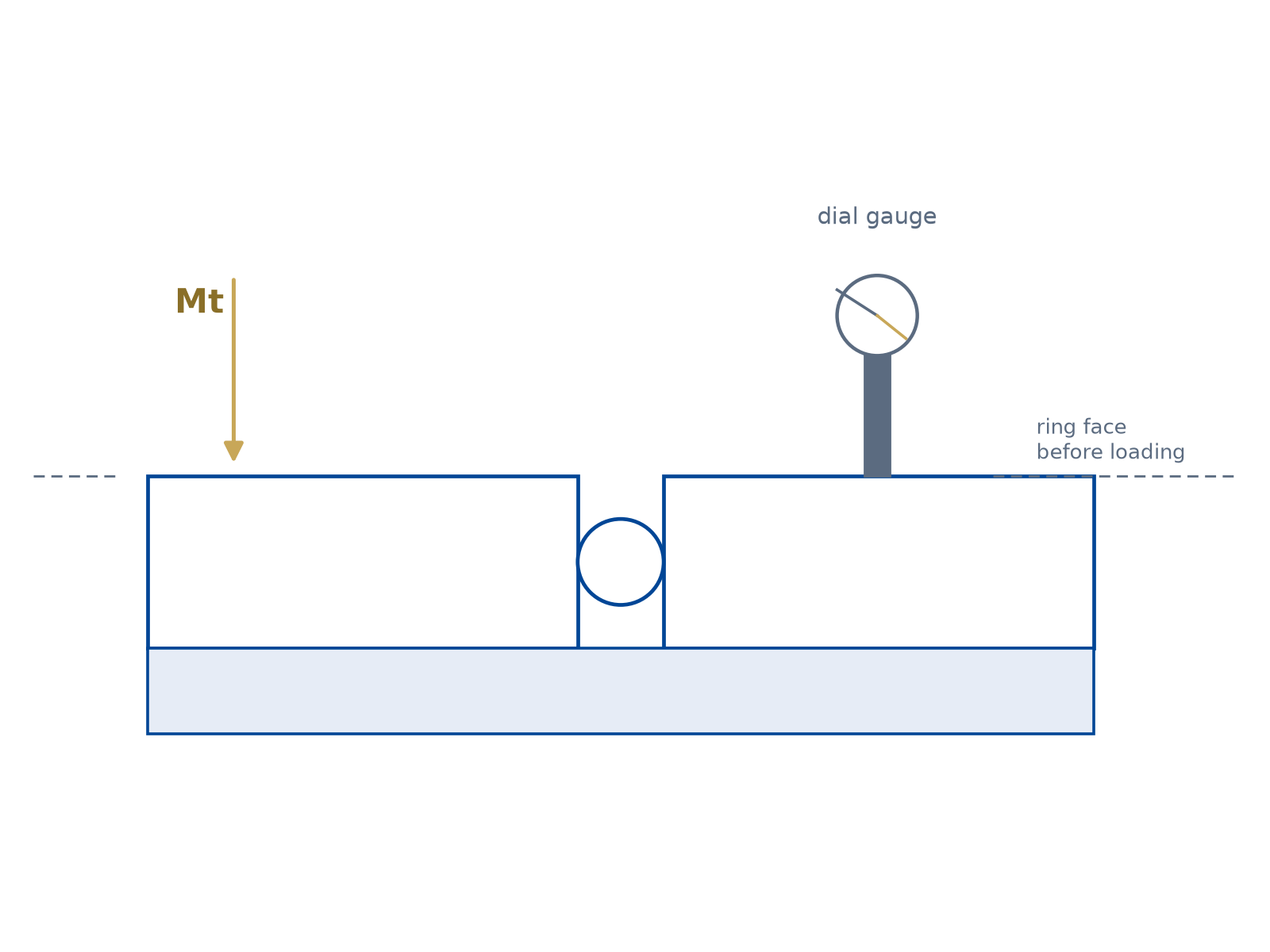
Measuring axial clearance with a dial gauge before start-up. Keep the reading: it is the reference for every later check.
Grease the ring straight after mounting, through the nipples, turning it as you go, until fresh grease comes out of the seals all round the circumference. The gear is not greased at the factory, only protected, so grease the teeth as well. A lithium soap grease with EP additives, NLGI class 2, covers most applications.
5. The First Weeks and Routine Checks
Bolted joints settle. Between the third and the twelfth week of operation, retighten all attachment bolts to the same torque, in the same two passes. Do it again after a long shutdown and at least once a year. If a bolt has clearly lost its preload, replace that bolt and the two next to it, one at a time, using the same method.
Check the seals every six months, keep grease on the sealing lip, and look at the clearance value once a year or every 2000 operating hours. When a bearing is replaced, replace the bolts with it. Reusing stretched bolts is a common reason for a second failure within a year.
If the clearance has grown noticeably from the value you recorded at installation, the raceway is wearing. Send us the old reading and the new one, plus the working hours, and the condition can be judged from real numbers rather than from noise or feel.
6. What We Make
Anhui Yuanfeng Slewing Rings Co., Ltd. makes slewing rings from 200 mm to 6000 mm in 42CrMo and 50Mn, with induction hardened raceways, in single row four point contact ball, crossed cylindrical roller and three row roller designs, with internal or external gear. Dimensions are checked on an in house Zeiss coordinate measuring machine, and we hold ISO 9001 and CE certification.
We work from your drawing or from a full set of dimensions. A first or replacement ring can be ordered as a single piece; once that first ring is approved, the drawing is kept on file and repeat orders for other machines of the same model are produced against it, so no measuring work is repeated and both lead time and unit price improve with quantity. Typical production time is around 40 days, with freight quoted separately. We do not reverse engineer parts and we do not design bearings from scratch.
Frequently Asked Questions
Q: What torque should I use for the bolts?
Grade 10.9 bolts with lightly oiled threads: about 285 Nm for M16, 560 Nm for M20, 970 Nm for M24 and 1930 Nm for M30. If the drawing supplied with the bearing gives a value, use that one instead.
Q: The ring does not turn evenly after tightening. What now?
A repeating tight spot usually means the mounting face is not flat or the ring has been pulled down on one side. Loosen the bolts in the area of the tight spot, check the face for burrs or paint, and tighten again in the two passes. Do not run the machine with a tight spot in the rotation.
Q: Do the bolts need retightening later?
Yes. Once between the third and twelfth week of operation, then at least once a year and after a long shutdown. This is normal settling, not a fault of the bearing.
Q: What do you need to quote a replacement ring?
A drawing, or the dimensions if there is no drawing: outer and inner diameter, height, bolt pattern and hole size, gear module and number of teeth, and the clearance condition the machine needs.
Send us your drawing or your dimensions.
Leave a message with the ring size, the bolt pattern and the application, and we will come back with a quotation.
Anhui Yuanfeng Slewing Rings Co., Ltd.
CE & ISO 9001 Certified Manufacturer
Web: www.ahyfeng.com | Email: office@ahyfeng.com / Daphne@ahyfeng.com
Tel: +86-18298009271 | WhatsApp: +86 13965019293